Marathon – A Breakthrough in Locomotion and Autonomy
Overview
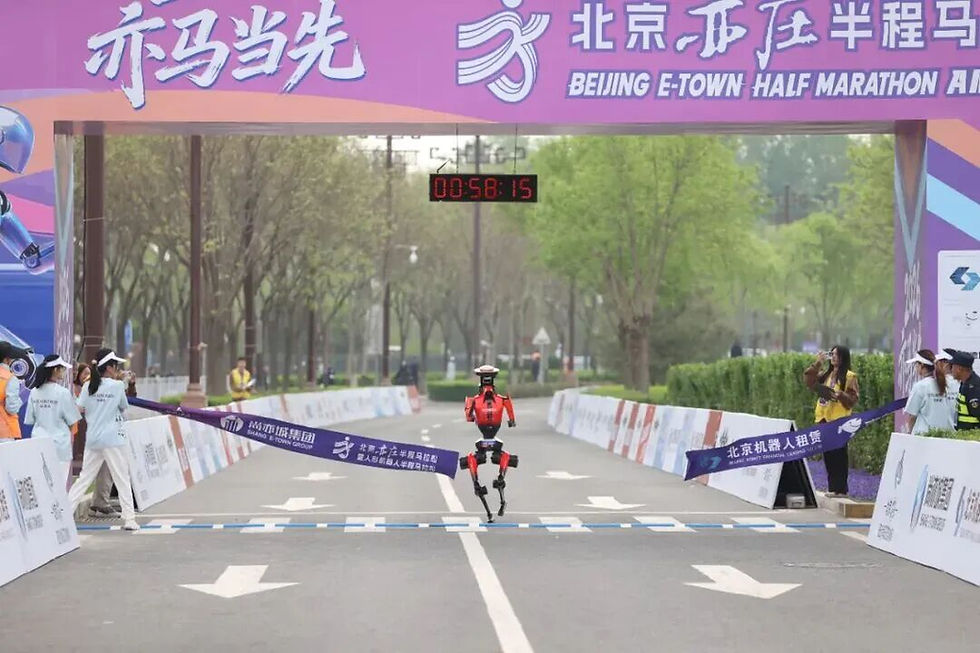
On April 19, 2026, Beijing Yizhuang hosted the world’s first half‑marathon for humanoid robots. This was not a gimmick but a rigorous engineering test: 21.0975 km, 22 turns, slopes, and outdoor conditions. EastGate AI analyzed the results to assess locomotion, autonomy, and durability.
Key Results
Participation growth
The second edition of the event saw substantial growth. In 2025, only 20 teams participated, with roughly six brands or robot types represented and no international presence. In 2026, the field expanded to over 80 enterprise teams and more than 20 university teams, encompassing 26 brands and over 300 humanoid robots. Five international teams from Germany, France, Portugal, and Brazil also took part, marking the first global participation in the event.
Winner and performance leap
Winner: Honor “Lightning” (Qitian Dasheng Team) – 50 minutes 26 seconds (net time).
Faster than human world record (57:20) by nearly 7 minutes.
2.8× faster than the 2025 champion (Tiangong Ultra, 2h40m42s).
Honor swept the top three positions, all in fully autonomous mode.
Speed highlight
During pre‑race testing, Unitree H1 reached 10 m/s (36 km/h) – close to Usain Bolt.
In the actual race, Unitree H1 fell and was carried off – demonstrating the gap between peak speed and race reliability.
Autonomy milestone
Nearly 40% of teams completed the course using full autonomous navigation (no remote control).
The champion robot, Honor “Lightning,” changed batteries only once (at 10.6 km) and recovered autonomously after a collision using its dynamic balance algorithm.
New entrants from adjacent industries
Honor (smartphone) and Autonavi (internet) participated for the first time. Autonavi launched “Tutu,” a quadruped robot capable of fully autonomous outdoor operation, positioned as a smart guide dog for the visually impaired.
Technical Significance
From “error‑prone” to “land‑speed” – In one year, humanoid running capability has surpassed elite human athletes.
Autonomous navigation is now scalable – 40% of teams achieved zero remote control.
Fall recovery works – Several robots fell and got up without external help.
Remaining Challenges (Beyond Running)
As the industry’s own data shows:
Manipulation lags behind locomotion – Fine motor skills, grasping, and assembly progress slowly.
Data bottleneck – The gap between needed and available multi‑modal training data is at least two orders of magnitude. Generating 10,000 hours of training data on one robot costs over ¥1 million.
No “ChatGPT moment” yet – Unitree’s founder Wang Xingxing stated: “If AI breakthroughs happen in the next 2‑3 years, annual shipments could suddenly reach hundreds of thousands or even a million units.”
Implications for European Buyers
The marathon validates that legs and outdoor autonomy are becoming production‑ready.
The gap is no longer about “if” robots can move autonomously, but when the same reliability will be applied to manipulation.
EastGate AI advises European clients to start pilot planning in high‑pain use cases (patrol, inspection, logistics) while watching for manipulation breakthroughs.
Conclusion
The 2026 Beijing humanoid robot half‑marathon was a genuine engineering milestone. Running performance has surpassed human records, and autonomous navigation is scaling. However, industrial manipulation remains the bottleneck. For European buyers, the marathon is a signal to begin systematic evaluation – not mass deployment, but strategic piloting.
Images credit via WeChat Moments. Article copyright © EastGate AI
EastGate AI
Bridging China’s robotics innovation with European industry
email: inquiries@eastgate-ai.com


Comments